
1963 · Citroën
Citroën ID Cabriolet 1963 for sale
Citroen ID Cabriolet '63
Red
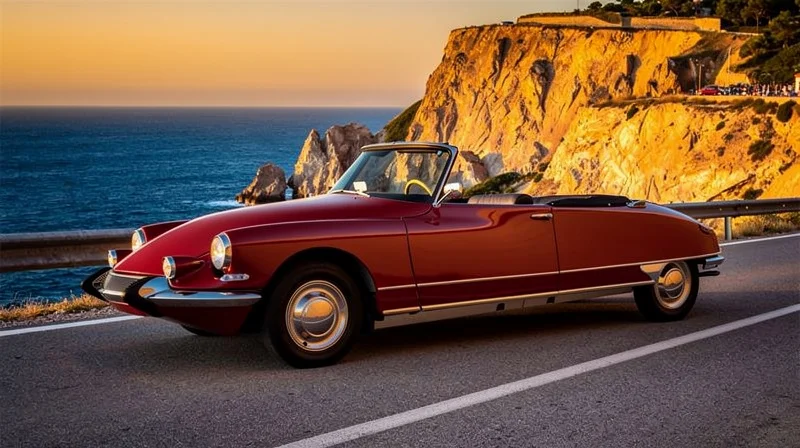
Photo 1 / 21
The story
Fully restored, beautiful The lowest mileage you will ever see on an ID convertible Bodywork – a work of art – made by the French coachbuilder Henri Chapron, with certificate In mintest condition of the mint With many invoices, documents, and certificates Presentation video: Click here According to many, the Citroën DS is the most beautiful car of the twentieth century. The déesse, which means "goddess" in French, was unveiled at the 1955 Paris Auto Show. During the Paris Auto Show, it was crystal clear that this car would be a great success, 12,000 models were sold just at that show and the following week that figure rose to 80,000, which was an absolute record. The DS was produced in various body styles until 1975. In total, about 1.3 million were delivered. The DS, known in Spain as tiburón, which means "shark", and in the Netherlands as snoek, which means pike, to name just two of its many nicknames, was the successor to the already revolutionary Traction Avant. To maintain this revolutionary trend, the DS was designed using countless cutting-edge technologies, it is almost impossible to list them all. Let's do it. Citroën moved away from mechanics and chose to use more hydropneumatics: the hydropneumatic suspension offers wonderful ride comfort that perfectly meets the post-war road conditions, and to make the most of combustion in the engine, they designed a hydraulic disc clutch, which prevents power loss during clutch engagement. This clutch had to be operated with a lever on the steering wheel. Additionally, the single-spoke steering wheel significantly increased safety. The DS was the first mass-produced car with disc brakes on the front wheels, which also improved safety. It was the first car with plastic fuel lines, and the dashboard was entirely made of plastic, at the time the largest piece of plastic ever produced industrially. The front of the car was built so that the center line of the steering mechanism coincided with the center line of the wheel, ensuring that the car could continue to accelerate and drive straight even with a flat tire. Even the lighting was revolutionary: the headlights rotated with the movement of the steering wheel so that the driver could quickly anticipate on winding roads at night. But that's not all: the window frames were designed to be so thin that there was no longer any blind spot, the roof was made of very lightweight fiberglass to further lower the center of gravity, and the engine is located behind the front axle, making it a mid-engine car. A mid-engine design improves road grip and maneuverability. The usability of the DS was anything but conventional due to numerous new features, which is why the car was sometimes considered too revolutionary and mainly sought after by early innovators. To reach a broader audience frightened by high technology, Citroën introduced the ID in 1956. The ID was a more economical and conservative DS with a higher average level and less sophistication. Citroën ID The Citroën DS was considered too futuristic by the people, even though the DS later became a bestseller, this led to sales that did not fully meet its potential. Therefore, Citroën decided to design a simpler version with less technological sophistication for the market. This simpler DS was called ID, which is an abbreviation of the French word for 'idea'. Many devoted Citroën customers also admitted they were not ready for the DS, even though they bought one. The instruction manuals helped clarify many things but were rarely read thoroughly. After purchase, the DS also proved to be expensive to maintain due to all its technological sophistication. In 1957, a wave of relief followed when the Citroën ID came to life. It was a less sophisticated version of the DS, with the same Citroën charm and vibe. This time, a clutch pedal, a more conventional gear lever, and a more user-friendly braking system were built. The dashboard of the DS was also replaced for better usability. Technical information: Bodywork Length (cm): 486 (191 inches) Width (cm): 179 (70 inches) Height (cm): 142 (56 inches) Wheelbase (cm): 313 (123 inches) Weight (kg): lbs) Mechanics Engine: 1911 cc inline four mid-engine Displacement: 8 Fuel system: 1 Solex carburetor Transmission: 4-speed manual Drive: FWD Power: 79 hp (59 kW) at 4250 rpm Torque: 142 Nm at 3000 rpm Top speed: 145 km/h (90 mph) Read more
Technical specifications
| Anno | 1963 |
| Exterior color | Red |
Vehicle history
Listing created
8/8/2026
Price
159.950 €
Prezzo fisso
By contacting the seller you accept AutoEpoque's Terms and Conditions.
Oldtimerfarm BV
Verified seller
- Based in
- Aalter, BE
- Member since
- 2026
Buyer protection
Your payment stays protected until delivery and vehicle verification.