
1969 · Porsche
Porsche 908 Langheck 1969 for sale
Porsche 908 Langheck 1969
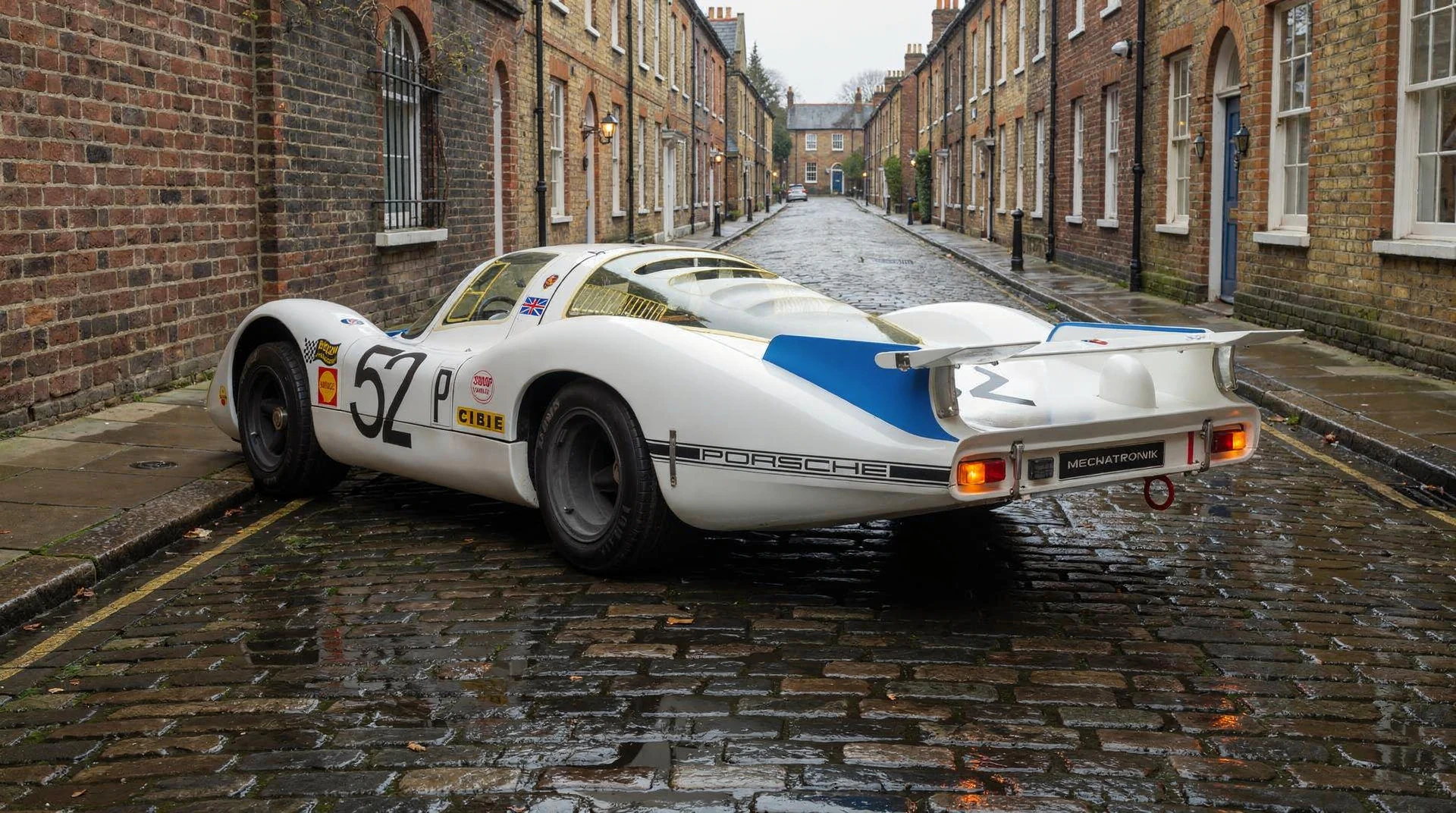
Photo 1 / 13
The story
Porsche 908 Langheck from 1969. Daytona 24h Poleposition 1969 Le Mans 24h Participant 1975 Targa Florio Participant 1970 One of 18 units built and about 5 units remaining 908 Langheck Porsche Works car Le Mans Classic and Goodwood 2023 Fully restored It is one of the most important racing cars in the history of the company and marks a decisive milestone in Porsche's rise to a dominant force in international endurance motorsport in the late 1960s. The model was developed as a successor to the successful Porsche 907, after the FIA had set the engine capacity limit for the prototype class to three liters for the 1968 season. With the 908, Porsche achieved for the first time a racing car with an eight-cylinder engine specifically designed for these regulations, emphasizing the brand's ambition to be competitive in the fight for overall victories in the major endurance classics. Development took place under the technical direction of Ferdinand Piëch, Hans Mezger, and Helmuth Bott, whose team of engineers designed the Porsche 908 for maximum efficiency, reduced weight, and high reliability. The heart of the vehicle was a three-liter air-cooled eight-cylinder boxer engine, with four overhead camshafts and mechanical injection. Depending on the version, the engine produced up to 370 hp and was characterized by great responsiveness and exceptional stability. The transmission was via a specially designed five-speed racing gearbox for the rear wheels. Thanks to its reduced weight and balanced weight distribution, the 908 was already considered one of the most technically advanced prototypes of its time at the time of its presentation. The chassis consisted of a lightweight aluminum tube frame, while the body was made of fiberglass-reinforced plastic. Porsche continued to develop the 908, adapting it to the different requirements of the circuits. For high-speed circuits like Le Mans and Daytona, the famous Langheck version was created with optimized aerodynamics and reduced air resistance. This reached a top speed of 320 km/h with a weight of only 700 kg. For twisty circuits, open Spyder versions were developed, which offered advantages due to their even lower weight and greater agility. The various evolutionary stages of the 908 formed the basis for numerous subsequent Porsche racing cars and significantly contributed to the brand's technical development in motorsport. Already in its first season, the Porsche 908 achieved significant successes at the international level. Victories and podium finishes in the World Sports Prototype Championship races confirmed the potential of the new vehicle. In particular, in the 1969 season, the 908 became one of the most successful racing cars of its time and played a decisive role in winning the Manufacturers' World Championship for Porsche. Its competitiveness against significantly more powerful competitors was primarily based on its reduced weight, aerodynamic efficiency, and reliability. Today, the Porsche 908 is considered one of the most important sports prototypes of the 1960s. It stands at the boundary between the first Porsche racing cars and later vehicles like the Porsche 917 and embodies the brand's engineering philosophy in its purest form. Due to its limited production number, exceptional racing history, and technical significance, the Porsche 908 is now one of the most sought-after and valuable racing vehicles in Porsche's history. Chassis 023 is one of the 18 908 Langheck built, of which it is said that only five units still exist in this configuration. Immediately after its completion in January 1969, the vehicle was used by Porsche itself at the 24 Hours of Daytona, where it was driven by official drivers Vic Elford and Brian Redman. They brought the 908 to achieve the best lap time of all participants in qualifying, securing the pole position. In the actual race, the vehicle had to retire due to technical problems. Throughout its career, the car remained closely linked to the official Porsche program and was subsequently developed under the direction of Hans Dieter Dechent for Martini Racing. For the 1970 season, it was converted to the open Spyder configuration "Flunder". In this configuration, chassis 023 participated in numerous races. Documented engagements include races at Imola, Zeltweg, and the legendary Targa Florio. After its active career as an official car, the vehicle passed into the hands of French driver Christian Poirot, who preserved the Porsche with his family for decades and continued to use it successfully in motorsport. The highlight was in 1975 when it participated in the 24 Hours of Le Mans, but the vehicle with starting number 3 did not complete the race due to a defective driveshaft. The ownership history is well documented and includes few owners over many decades. In 2017, chassis 023 was sold in Monaco. Subsequently, the 908 underwent a complete and demanding restoration, which lasted until 2022 and during which the car was returned to its original closed Langheck configuration. Just as the car left the Porsche factory at the time and participated in Daytona. During this work, the body, chassis, transmission components, and numerous details were restored, with great attention to historical authenticity. The available appraisals describe the condition of the vehicle as excellent and particularly emphasize the quality of the restoration work. After the successful work, the owner participated in Le Mans Classic and the Goodwood Festival of Speed. In addition, the Prince of Monaco exhibited the 908 as a guest specimen in his automobile museum in Monaco. Today, chassis 023 presents itself as a rare opportunity to acquire a Porsche sports prototype with a documented factory history, participation in legendary races, a history of prominent drivers, and verifiable provenance. Extensive documentation, historical documents, and appraisals accompany the vehicle and underline its particular importance in the history of Porsche motorsport. A unique enrichment for any Porsche collection worldwide and a ticket to the most prestigious historic motorsport events around the world.
Technical specifications
| Anno | 1969 |
Vehicle history
Listing created
8/13/2026
Price
Price on request
Prezzo fisso
By contacting the seller you accept AutoEpoque's Terms and Conditions.
Mechatronik GmbH
Verified seller
- Based in
- Pleidelsheim, Baden-Württemberg
- Member since
- 2026
Buyer protection
Your payment stays protected until delivery and vehicle verification.