
1971 · Porsche
Porsche 917/10 1971 for sale
Porsche 917/10 1971
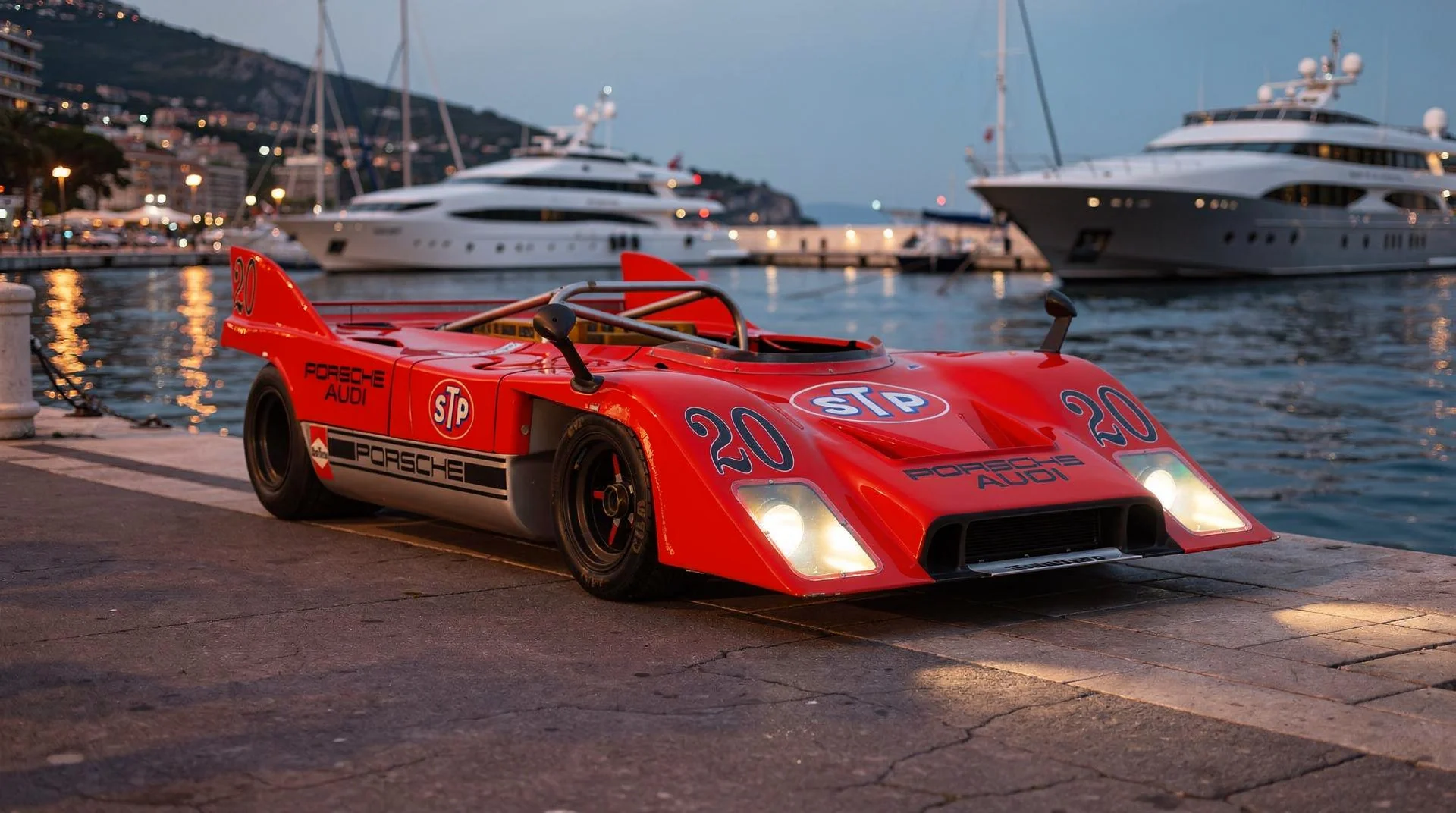
Photo 1 / 13
The story
One of two 917/10 with naturally aspirated engine, built in the summer of 1971 Successful racing history Delivered to and driven by Jo Siffert Known uninterrupted history Long ownership by Willi Kauhsen, including an extremely successful racing career Fully restored to original Can-Am specifications One of the greatest sports prototypes ever built Detailed history available for consultation The Porsche 917 is considered by collectors to be the most sought-after racing car that the brand has ever built, achieving record prices regardless of market conditions for two decades. The reason is clear: the 917 represented the culmination of a development that began in 1966 with the 906 model and ushered in a new era for Porsche racing cars. Although the 908 with its three-liter engine had won the world championship in 1969, at Porsche they feared that its performance would not be sufficient to achieve overall victory at Le Mans - a goal that was as significant for the manufacturer as triumphing against the Ford GT40, the Lola T70, and the anticipated McLaren Group 4 coupe. When the FIA reduced the production requirements for homologating five-liter Group 4 sports cars from 50 to 25, the Porsche factory saw its opportunity, and the 917 was born. Starting from the 908 chassis, the 917 with a 4.5-liter twelve-cylinder engine was presented at the Geneva Motor Show in March 1969. On May 1, after 25 units had been built, the FIA homologated the 917 as a Group 4 sports car. Despite its enormous power, the 917 initially struggled. Its challenging driving behavior scared off many factory drivers, who preferred to drive the more manageable 908. During practice at Le Mans in 1969, drivers reported that the car became unstable at speeds over 200 mph on the straights. However, the 917 would almost be victorious on its debut there - an impressive testament to its extraordinary power and speed. However, the 917 achieved its first victory in August 1969 at Zeltweg, Austria, with a coupe in the short-tail version. During the winter, the John Wyer racing team (JW Racing) took over the employment of the 917 from the factory. Wyer had the rear of the car modified - inspired by the design of the Lola T70 Coupe - drastically improving the previously criticized driving characteristics of the car. Under the guidance of Wyer's Gulf Oil-sponsored team, the 917 won the manufacturers' world championship in 1970 and 1971, before being banned again due to a regulation change favoring three-liter prototypes. The first overall victory for Porsche at Le Mans was achieved by a 917K fielded by the Porsche Salzburg team. In total, the 917 achieved 15 victories in 24 world championship races in those years - 11 of which were with Gulf-Wyer cars. Considering the impressive success record of this racing car, it is clear that the 917 is among the five most significant sports prototypes in history. No other two-seater racing car has been able to boast more successes in the manufacturers' championship, in the Can-Am series, and in the Interserie. Among its greatest triumphs are victories in the 24 Hours of Le Mans, the 24 Hours of Daytona, the 12 Hours of Sebring, and the 1000-kilometer races at Monza, Spa, and Nürburgring. Whatever track is mentioned - the 917 was there and dominated it. As often happens, the decisive engine behind the multimillion-dollar development of the 917 was the desire to win the legendary 24 Hours of Le Mans. But typical of Porsche, it did not stop at this goal: the company also turned its attention to the prestigious American Can-Am championship. Indeed, at that time about half of Porsche's total production was going to the United States - with further growth potential in sight. Already in 1969, Porsche had designed and tested the first open versions of the 917 specifically for the Can-Am series. In this championship, vehicles with enormous power were present, which could only be controlled by drivers with extraordinary endurance, determination, and driving skill. In this context, the talented Swiss driver Jo Siffert entered the scene - a driver who brought with him the ideal conditions to successfully move the 917 in this demanding racing series. Jo Siffert was at that time the most important driver for the official Porsche team. Not only had he repeatedly proven to be one of the fastest drivers of his generation, but he also showed remarkable loyalty to Porsche. Born in Fribourg (Switzerland), Siffert began his motorsport career initially on two wheels and achieved early successes in motorcycling before entering Formula 1 in 1962 as a private driver. He later raced for the Swiss team Scuderia Filipinetti and from 1964 for Rob Walker Racing, where he achieved victories and gained international notoriety with his calm driving style and his distinctive helmet with the Swiss cross. In 1969, Siffert participated as a semi-official Porsche driver in the North American Can-Am series, where he drove the open 917 PA (Porsche-Audi). The following year he took on a special role: he participated in the legendary Steve McQueen film Le Mans. The 24 Hours of Le Mans in 1970 also served as a set for filming - and the Porsche 917 shown in the film, painted in Gulf colors, driven by the protagonist Michael Delaney, was actually driven by Jo Siffert and Brian Redman. Steve McQueen, who was a close friend of Siffert, was heavily inspired by him for the portrayal of his cinematic character Michael Delaney - down to details like the racing suit and watch that matched Siffert's personal style. In 1971, Jo Siffert took a further step: for the Can-Am season, he purchased a specially built Porsche 917/10 Spyder with an aluminum chassis - a unique piece with chassis number 917/10-002, which is now one of the most desired models. The vehicle was completed in July 1971 and subsequently completed only 24 test laps on the Can-Am track in Weissach. It was equipped with a 4.5-liter engine and weighed only 733 kilograms. Already the next day, the car was air-freighted to the United States to Watkins Glen. There, the 917 received a new identity - marked by Siffert's entrepreneurial spirit and creativity. As an experienced driver and shrewd businessman, Siffert secured a sponsorship contract with STP just before the start of testing at Watkins Glen. Overnight, the car was repainted from its original white into a distinctive fluorescent red and fitted with a large STP logo - a visually and marketing-wise striking appearance. Siffert's team consisted of two talented Swiss race mechanics: Edy Wyss and Hugo Schibler. Both were instrumental in the development and construction of the vehicle, which had been completed in less than four weeks at factory 1 in Zuffenhausen. Together they formed a close-knit unit that made the Porsche 917/10 Spyder an icon of the Can-Am era. The race weekend at Watkins Glen took place from July 23 to 25, 1971, and offered a very interesting duel between the 917K and the 917/10. It is noteworthy that during the same weekend at Watkins Glen, a six-hour FIA world championship race took place, in which Siffert also participated. His best time with the 917K was 1:08.510, compared to 1:08.640 with the 917/10. This clearly demonstrated that the brand new /10, still underdeveloped, was just as fast as the factory-supported and well-tested 917K. However, perhaps the most impressive thing is the fact that Siffert finished second in the FIA race and achieved a respectable third place in his first Can-Am race with chassis 10-002. After the debut at Watkins Glen, Jo Siffert, his team, and the 917/10 Spyder remained in the United States for the rest of the season to participate in other races in the Can-Am series. The team achieved a series of remarkable results: by the end of the season, Jo Siffert finished fourth in the overall standings with the 917/10 - an exceptional result, especially considering that he only participated in six of the ten possible races with chassis 917/10-002. Tragically, this success story came to a sudden halt: in October 1971, Jo Siffert died in an accident during a Formula 1 race. His death meant not only a great loss for Porsche but also for the entire motorsport world, which lost one of the most talented and charismatic drivers of his era. After Siffert's death, the Porsche 917/10 was sold to Willi Kauhsen from Aachen. Kauhsen was a close confidant of Siffert and had strong ties to the official Porsche team, for which he worked as an independent test driver. Due to his intense work with the 917 cars, he is probably considered the driver with the most kilometers ever driven in a Porsche 917 - a testament to his immense experience and technical understanding of this complex racing machine. The chassis 917/10-002 then returned to the factory racing department in Zuffenhausen, where it was extensively refurbished and prepared for use in the European Interserie series. This racing series was fundamentally the European variant of the Can-Am series and served as a subsequent platform for powerful sports prototypes after the manufacturers' championship regulations had changed. Following this refurbishment, numerous 917 models participated in the Interserie, which soon became a popular venue for the most spectacular and powerful racing cars of their time. The 917/10-002 continued its impressive success story there - now under the guidance of one of the most experienced Porsche drivers ever. With chassis 917/10-002, Willi Kauhsen achieved notable successes and became a prominent figure in the Interserie. He engaged in thrilling duels with Leo Kinnunen, who raced with a factory-supported 917, and with numerous former Can-Am vehicles - including McLaren, BRM, and Lola, which debuted for the first time on European circuits. After the first three races, Kauhsen had his car fitted with a turbo engine to overcome the growing performance competition. The modification made the 917/10-002 a formidable opponent for the most powerful cars of that time. Kauhsen participated in nine races in the 1972 season, achieving seven podiums and finishing the championship in second place in the overall standings - an extraordinary result and an impressive continuation of the legendary 917's success story. But the year ended tragically: in September 1972, Kauhsen suffered a puncture at the Nürburgring, which damaged the 917. Fortunately, Kauhsen himself sustained only minor injuries. Despite the incident, he decided to keep the vehicle. The damaged racing car ultimately remained in the possession of his brother for 25 years - a silent testament to the tumultuous history of one of the most fascinating Porsche racing cars of all time. In 1998, the Porsche 917/10-002 underwent a complete restoration. The vehicle was completely rebuilt - by the same Porsche experts who had already been involved in the original development at Porsche in the early 1970s. This authentic restoration ensured that every detail of the car matched the condition at the time of delivery, both technically and aesthetically. Upon completion of the work, the project was reviewed and officially approved by Porsche itself. This is confirmed by a letter from Klaus Bischof - a long-time Porsche employee, who at the time was responsible for chassis 002 on behalf of Willi Kauhsen. Bischof, former head of the Porsche Rolling Museum, confirmed in it the authenticity and compliance of the restoration carried out according to the state of the car in 1972. For the reconstruction of the Porsche 917/10-002, the original Porsche construction drawings and the original chassis equipment, which were directly in the possession of Porsche AG, were used. This allowed for the reconstruction to be carried out with maximum precision and authenticity - in perfect line with the factory's original standards. The engine and transmission, both original contemporary components from the era of the 917, were completely overhauled by renowned 917 engine specialist Gustav Nietsche. Nietsche, considered one of the leading experts on the complex twelve-cylinder engines of these vehicles, ensured that the transmission and technology once again matched the exact specifications of the then-current Can-Am racing version. The bodywork was made according to the 1971 Can-Am specifications and subsequently painted in the characteristic STP red - that iconic color that made Jo Siffert's 917/10 famous worldwide during its American racing season. Thus was born a vehicle that represents not only an authentic technical resurrection but also a visual one of the legendary 917/10-002. Upon completion of the costly restoration, the fully rebuilt Porsche 917/10-002 was once again destined for its purpose - driving. Willi Kauhsen himself presented the vehicle at various demonstration and classic car events, including prestigious appearances at the Goodwood Festival of Speed and the AvD-Oldtimer-Grand-Prix at the Nürburgring. These engagements impressively demonstrated that the 917/10 is not just a museum collectible piece, but is still a fully functioning racing car of extraordinary charm and performance. The next chapter of the 917/10-002 took place in the United States, where the car was displayed for over 8 years in a renowned private collection. In 2008, it was purchased by a German collector, who kept it until 2012. A further change of ownership followed at the end of 2012, and the 917 found its new home in an extraordinary Porsche collection in Munich. After the purchase of the Porsche 917/10-002, the new owner decided to return the car to its original delivery livery - the white paint that the vehicle wore when it was originally shipped to the United States. At the same time, the previously distinctive and angular bodywork was replaced with a rounder shape that matched the later development stages of the 917. In this configuration, the vehicle was driven in 2015 by racing legends Jürgen Barth and Gérard Larrousse during the Dix Mille Tours at the Circuit Paul Ricard - a symbolic appearance that impressively underscored the historical importance of the 917/10. In 2017, the owner decided to return the 917/10 to Jo Siffert's legendary STP livery - that iconic fluorescent red, inextricably linked to the Can-Am era and Siffert's appearances. The still-existing bodywork was also reattached to the car. Additionally, the vehicle was fitted with headlights to allow for use in the Peter Auto CER (Classic Endurance Racing) series. Thus, another circle was closed in the tumultuous history of this unique Porsche racing vehicle. In recent years, the car has participated with its owners in numerous historic motorsport events, highlighting the almost infinite possibilities that this racing legend offers to its future owner.
Technical specifications
| Anno | 1971 |
Vehicle history
Listing created
8/13/2026
Price
Price on request
Prezzo fisso
By contacting the seller you accept AutoEpoque's Terms and Conditions.
Mechatronik GmbH
Verified seller
- Based in
- Pleidelsheim, Baden-Württemberg
- Member since
- 2026
Buyer protection
Your payment stays protected until delivery and vehicle verification.